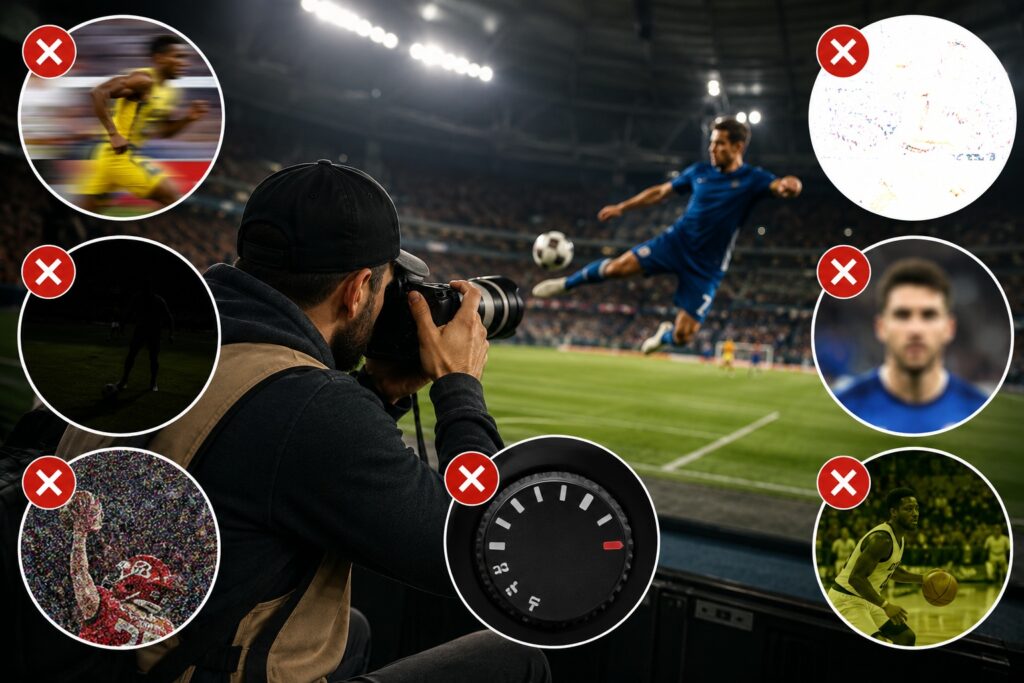
Back Button Focus is one of the most valuable techniques sports photographers can learn. Once you separate focusing from the shutter button, you’ll notice faster reactions, more consistent focus, and fewer missed shots. Whether you’re photographing a football player charging down the field, a sprinter crossing the finish line, or a basketball player soaring toward the hoop, this simple camera setting can dramatically improve your keeper rate.
Many professional sports photographers rely on Back Button Focus because it gives them greater control over autofocus, especially when subjects are moving unpredictably. If you’ve ever wondered how professionals consistently capture razor-sharp action shots, Back Button Focus is one of their biggest secrets.

Back Button Focus Explained for Sports Photographers
Capturing the perfect sports photograph often comes down to a fraction of a second. Athletes rarely stay still, and their movements can change direction instantly. A camera that struggles to keep up can easily produce soft or completely out-of-focus images.
Back Button Focus (BBF) changes the way your camera focuses by assigning autofocus to a button on the back of the camera instead of the shutter release. This allows photographers to independently control focusing and taking the picture, resulting in faster, more accurate autofocus during sports.
Whether you’re just beginning sports photography or looking to improve your success rate at professional sporting events, understanding Back Button Focus can transform your photography.
What Is Back Button Focus?
By default, most cameras perform two actions when you half-press the shutter button:
- Activate autofocus
- Meter the exposure
When you fully press the shutter, the camera captures the image.
Back Button Focus separates these actions.
Instead of half-pressing the shutter to focus, autofocus is activated using a dedicated rear button, commonly labeled:
- AF-ON
- AE-L/AF-L
- AF Button
The shutter button then becomes responsible for only one task:
Taking the photograph.
This separation gives photographers complete control over when the camera focuses.
Why Sports Photographers Love Back Button Focus
Sports move fast.
Football players suddenly change direction.
Soccer players sprint toward the goal.
Baseball players swing in milliseconds.
Cyclists race past at incredible speeds.
Every second counts.
With traditional autofocus, every half-press tells the camera to refocus.
Sometimes that’s exactly what you want.
Other times it causes the camera to hunt for focus right before the decisive moment.
Back Button Focus eliminates this problem.
Once you’ve achieved focus, the camera won’t refocus until you intentionally press the rear autofocus button again.
This creates much more predictable focusing.
The Biggest Benefits of Back Button Focus
Better Tracking of Moving Subjects
Continuous autofocus works exceptionally well with BBF.
Simply hold the AF-ON button while tracking an athlete.
The autofocus system continuously updates focus while your thumb remains on the button.
When the perfect moment happens, simply press the shutter.
No delay.
No unexpected refocusing.
This is ideal for:
- Football
- Soccer
- Hockey
- Basketball
- Motorsports
- Cycling
- Running events
Faster Reaction Time
Since focusing is already happening separately, your shutter button responds instantly.
You’re no longer waiting for autofocus confirmation.
This is especially valuable during:
- Goal celebrations
- Tackles
- Dunks
- Finish-line moments
- Diving catches
Milliseconds matter.
Easier Subject Recomposition
Sometimes the athlete isn’t positioned where you want them inside the frame.
With BBF:
- Focus once.
- Release the AF button.
- Recompose your shot.
- Take as many photos as needed.
The focus remains locked until you decide otherwise.
This is perfect for portraits of athletes before or after competitions as well.
Fewer Missed Shots
One of the most frustrating moments in sports photography is watching your camera focus on:
- the referee
- another athlete
- the crowd
- the goal post
- the fence
Instead of your intended subject.
Back Button Focus greatly reduces these accidental focus changes because the shutter no longer activates autofocus.
How Back Button Focus Works
Imagine photographing a sprinter.
With normal autofocus:
- Half press shutter.
- Camera focuses.
- Full press.
- Camera may refocus again.
Now imagine the athlete changes direction.
The camera might hesitate.
With BBF:
- Hold AF-ON.
- Camera continuously tracks.
- Release AF-ON when desired.
- Press shutter anytime.
The shutter never interrupts your focus.
How to Enable Back Button Focus
Every camera brand is slightly different, but the overall process is similar.
Canon
- Open Custom Controls.
- Disable autofocus from the shutter button.
- Assign AF-ON for autofocus.
Nikon
- Open Custom Settings.
- Select Autofocus.
- Disable shutter AF.
- Assign AF-ON.
Sony
- Open Custom Key Settings.
- Assign AF-ON.
- Disable AF with shutter.
Fujifilm
- Turn off Shutter AF.
- Assign AF-ON to a rear button.
- Customize button layout if needed.
Always consult your camera manual for model-specific instructions.
Best Autofocus Mode to Pair with Back Button Focus
Most sports photographers use:
Continuous Autofocus
Known as:
- AI Servo (Canon)
- AF-C (Sony, Nikon, Fujifilm)
This allows the camera to continuously adjust focus while your thumb remains on AF-ON.
Avoid Single Shot AF for fast-moving sports.
Best Camera Settings for Back Button Focus
Although every sport is different, these settings work well for most outdoor sporting events.
Shutter Speed
- 1/1000 sec
- 1/1600 sec
- 1/2000 sec
Fast enough to freeze movement.
Aperture
f/2.8–f/4 for subject isolation.
f/5.6–f/8 when photographing multiple athletes.
ISO
Adjust according to available light.
- ISO 100–400 outdoors
- ISO 800–3200 indoors
- Higher when necessary
Drive Mode
Use Continuous High Speed Burst.
Focus Area
Dynamic Area AF
Zone AF
Expanded Flexible Spot
These provide excellent athlete tracking.
When Should You Release the AF Button?
This depends on the situation.
Keep Holding It
When photographing:
- football plays
- soccer attacks
- hockey rushes
- basketball fast breaks
Continuous tracking keeps focus updated.
Release It
When:
- waiting for the athlete
- photographing awards
- shooting team portraits
- composing a creative frame
Focus stays locked.
Sports That Benefit Most from Back Button Focus
Nearly every sport benefits.
Football
Track quarterbacks and receivers with continuous focus.
Basketball
Perfect for drives to the basket.
Soccer
Follow players sprinting across the pitch.
Baseball
Track runners stealing bases.
Tennis
Follow serves and volleys.
Cycling
Maintain focus during high-speed passes.
Motorsports
Excellent when combined with panning.
Swimming
Track swimmers approaching the wall.
Common Mistakes Beginners Make
Forgetting to Press AF-ON
This happens frequently during the first week.
Practice until it becomes muscle memory.
Using Single Autofocus
Continuous AF is almost always the better choice for sports.
Letting Go Too Early
If the athlete is still moving, continue holding AF-ON.
Using the Wrong Focus Area
Avoid letting the camera automatically choose all focus points.
Instead, use:
- Zone AF
- Dynamic Area
- Expand AF
These provide better control.
Practice Exercises
Try these before photographing a live sporting event.
Exercise 1
Photograph passing cars.
Track each vehicle while holding AF-ON.
Exercise 2
Photograph cyclists at a park.
Practice continuous tracking.
Exercise 3
Photograph children playing.
Their unpredictable movement closely resembles many sports.
Exercise 4
Visit a local running trail.
Practice maintaining focus throughout an entire stride sequence.
Does Back Button Focus Work for Wildlife?
Absolutely.
Many wildlife photographers use the exact same technique because birds, animals, and athletes all move unpredictably.
If you enjoy photographing both sports and wildlife, learning BBF gives you an advantage in both genres.
Is Back Button Focus Worth Learning?
Without question.
It may feel awkward during the first few days, but once it becomes second nature, many photographers never switch back to traditional shutter-button autofocus.
Back Button Focus provides greater control, faster response times, and more reliable autofocus performance in demanding situations. Combined with continuous autofocus, burst shooting, and proper camera settings, it helps you capture more sharp, decisive moments and fewer missed opportunities.
If your goal is to consistently produce professional-looking sports photographs, mastering Back Button Focus is one of the smartest investments you can make. The technique requires no additional equipment, costs nothing to enable, and can significantly increase the number of sharp, action-packed images you bring home from every sporting event.
The written content on this page was generated by ChatGPT.