There is something unforgettable about capturing the exact instant a soccer player scores the winning goal, a sprinter crosses the finish line, or a gymnast sticks the perfect landing. These moments happen in fractions of a second, and once they are gone, there is no opportunity for a second attempt. That is what makes sports photography both exciting and demanding.
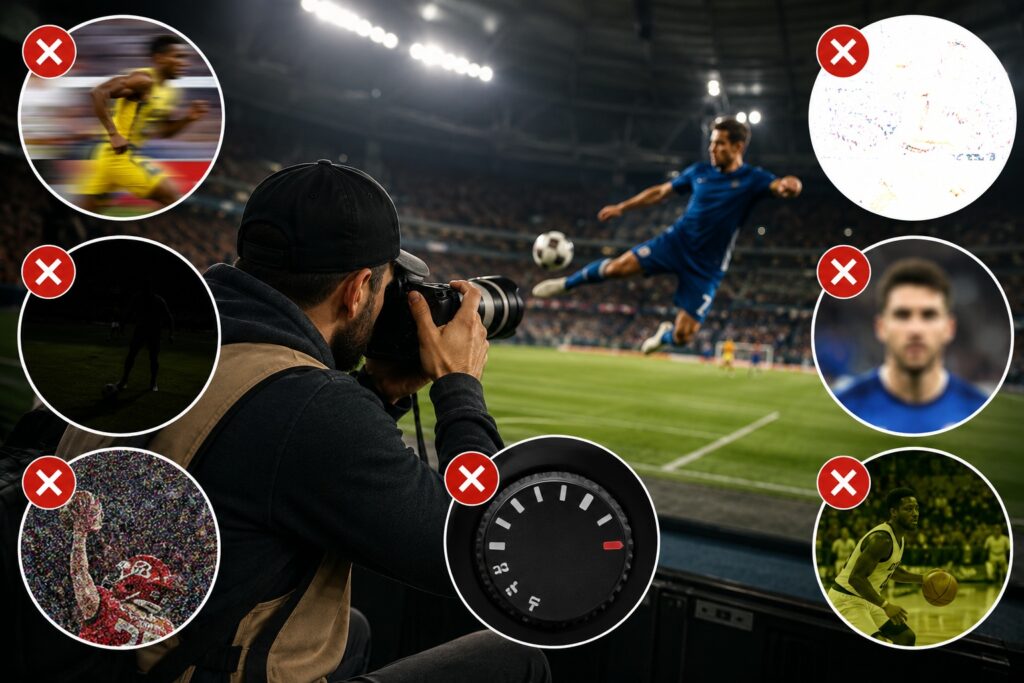
Many photographers spend hours researching the best camera bodies and telephoto lenses, believing that expensive gear alone will produce professional-quality images. While good equipment certainly helps, the camera settings you choose before and during the event often have a much greater impact on your final results. Even a top-tier camera cannot rescue an image if the shutter speed is too slow, the autofocus misses the athlete, or the exposure is incorrect.
Every sporting event presents unique challenges. Outdoor stadiums may shift from bright sunshine to overcast skies within minutes. Indoor arenas often have inconsistent artificial lighting. Fast-moving athletes rarely stay in one place long enough for you to make adjustments after the action begins. Because of this, understanding your camera settings is one of the most valuable skills you can develop.
Whether you are photographing youth sports, high school championships, amateur tournaments, or professional competitions, avoiding a few common mistakes can dramatically improve the quality of your action shots. This guide explores the most frequent camera setting errors photographers make at sporting events and explains how to avoid them with confidence.
Why Camera Settings Matter More Than Expensive Equipment
A high-end camera is only as effective as the person using it. Professional sports photographers consistently produce stunning images because they understand how every setting works together to capture motion, maintain sharp focus, and adapt to changing conditions.
Sports photography demands speed. Your camera must react instantly while maintaining focus on subjects that may be running, jumping, diving, or racing toward you. If your settings are not optimized before the action starts, the camera can struggle to keep up, leaving you with missed opportunities and disappointing results.
Taking a few minutes to prepare your camera before the event begins can make a significant difference in the number of sharp, well-exposed images you capture.
Mistake 1: Choosing a Shutter Speed That Is Too Slow
One of the quickest ways to ruin an action photograph is by using a shutter speed that cannot freeze movement. When the shutter remains open for too long, fast-moving athletes become blurry, and important details disappear.
This mistake often happens when photographers rely entirely on automatic camera settings or forget to adjust their shutter speed after moving from a bright outdoor field into a dimly lit gymnasium.
How to Fix It
Your shutter speed should match the pace of the sport.
As a general guideline:
- Walking or slow movement: around 1/250 second
- Running sports: 1/500 to 1/800 second
- Football, soccer, baseball, basketball, and volleyball: around 1/1000 second
- Motorsport, cycling, hockey, and similar high-speed action: 1/1250 to 1/2000 second
If you’re unsure, start with a faster shutter speed and adjust only if necessary.
Mistake 2: Staying in Single Autofocus Mode
Single autofocus is designed for stationary subjects. It locks focus once and assumes your subject will remain in place.
Athletes rarely cooperate.
The moment your camera locks focus, the player has already moved somewhere else.
A Better Approach
Switch your camera to Continuous Autofocus mode.
Depending on your camera manufacturer, this feature may be called:
- AI Servo
- AF-C
- Continuous AF
This allows your camera to continually adjust focus while tracking moving athletes, greatly increasing the likelihood of sharp images.
Mistake 3: Forgetting to Enable Continuous Shooting
Perfect timing is difficult, even for experienced photographers.
If your camera captures only one frame every time you press the shutter button, your chances of missing the peak action increase dramatically.
Professional sports photographers often use burst mode because it provides several opportunities instead of just one.
Why Burst Mode Helps
Continuous shooting captures multiple images each second, allowing you to choose the strongest frame afterward.
Rather than guessing the perfect instant, you record an entire sequence of movement, making it much easier to find the exact moment when the athlete’s expression, body position, and timing all come together.
Mistake 4: Keeping ISO Too Low Out of Fear
Many beginners hesitate to increase ISO because they worry about digital noise.
Ironically, this often creates a much bigger problem.
A low ISO forces your camera to use slower shutter speeds, which results in blurry action shots.
Modern editing software can reduce image noise remarkably well, but no software can restore details lost to motion blur.
Practical ISO Recommendations
Lighting conditions should determine your ISO.
For example:
- Bright sunshine: ISO 100 to 200
- Cloudy afternoons: ISO 400 to 800
- Outdoor evening games: ISO 800 to 1600
- Indoor arenas: ISO 1600 to 6400 or higher
Today’s cameras perform surprisingly well at higher ISO settings, making them much more usable than they once were.
Mistake 5: Using an Aperture That Limits Your Camera
Some photographers assume that using f/11 or f/16 will automatically produce better image quality.
In sports photography, however, these smaller apertures reduce the amount of light entering the lens.
As a result, your camera compensates by lowering shutter speed or increasing ISO.
Better Aperture Choices
Most sports photographers prefer wider apertures such as:
- f/2.8
- f/4
- f/5.6
These settings allow more light into the camera while also creating attractive background blur that helps athletes stand out from distracting surroundings.
Mistake 6: Allowing the Camera to Pick Every Focus Point
Automatic focus point selection works well for casual snapshots but often struggles during sporting events.
Your camera cannot always determine which player you intend to photograph.
Instead of focusing on your subject, it may lock onto spectators, fences, goalposts, or nearby players.
Improve Focus Accuracy
Selecting a specific focus area gives you much greater control.
Popular options include:
- Single Point AF
- Dynamic Area AF
- Zone AF
- Expanded Focus Area
Experiment with each mode to determine which works best for your sport and camera system.
Mistake 7: Ignoring White Balance
Colors play an important role in sports photography.
Incorrect white balance can make uniforms look unnatural and skin tones appear unrealistic.
Indoor venues often present additional challenges because multiple lighting sources can produce unusual color casts.
What Works Best
Auto White Balance performs surprisingly well in many situations.
If lighting remains consistent, manually selecting Daylight, Cloudy, Fluorescent, or Tungsten may provide more accurate and consistent colors throughout the event.
Photographers who shoot in RAW format can also fine-tune white balance during post-processing.
Mistake 8: Forgetting About Exposure Compensation
Sports uniforms vary dramatically in brightness.
Bright white jerseys may fool your camera into producing underexposed images, while dark uniforms can lead to overexposure.
Learning to use exposure compensation allows you to make quick adjustments without completely changing your camera settings.
Even small adjustments can improve image quality.
Mistake 9: Depending Too Much on Automatic Mode
Automatic shooting modes are convenient, but they cannot predict what matters most in a fast-moving sporting event.
The camera may prioritize a lower ISO over a faster shutter speed or choose an aperture that limits subject separation.
For greater consistency, many photographers prefer:
- Shutter Priority
- Manual Mode with Auto ISO
- Full Manual Mode in consistent lighting
These modes provide significantly more creative control.
Mistake 10: Arriving Without Testing Your Settings
Every sports venue has different lighting conditions.
An outdoor baseball field at noon looks very different from a basketball court illuminated by overhead lights.
Walking into an event without testing your camera almost guarantees missed opportunities.
Before the Game Starts
Take several test photographs during warm-ups.
Review them carefully for:
- Sharpness
- Exposure
- White balance
- Focus accuracy
- Histogram
- Noise levels
Making adjustments before the competition begins allows you to concentrate entirely on the action once play starts.
Mistake 11: Overlooking the Background
Sports photography is about more than freezing action.
A cluttered background filled with spectators, advertisements, parked vehicles, or equipment can distract viewers from the athlete.
Take a few moments to reposition yourself whenever possible.
Shooting from lower angles, using longer focal lengths, and selecting wider apertures helps simplify the background while drawing attention directly to your subject.
Mistake 12: Shooting Only JPEG
JPEG files are smaller and easier to share, but they sacrifice valuable image information during processing.
RAW files preserve significantly more detail, allowing greater flexibility during editing.
Benefits include:
- Improved highlight recovery
- Better shadow detail
- More accurate color adjustments
- Easier white balance correction
- Greater dynamic range
For photographers who plan to edit their sports images, RAW is usually the better choice.
Mistake 13: Never Reviewing Your Images During the Event
Constantly checking your LCD screen after every shot can cause you to miss important moments.
However, failing to review your images at all can allow problems to continue throughout the game.
Instead, inspect your photos during natural breaks such as halftime, timeouts, or race intervals.
Look for recurring issues and make adjustments before play resumes.
Recommended Camera Settings for Most Sports Events
If you are just getting started, these settings provide an excellent baseline for many outdoor sporting events.
| Camera Setting | Recommended Starting Point |
|---|---|
| Shutter Speed | 1/1000 second |
| Aperture | f/2.8 to f/5.6 |
| ISO | Auto ISO or 400 to 3200 |
| Focus Mode | Continuous AF |
| Drive Mode | High-Speed Continuous |
| File Format | RAW |
| White Balance | Auto White Balance |
| Metering Mode | Evaluative or Matrix |
These settings are not universal, but they offer a dependable starting point that can be adjusted according to the lighting and pace of the sport.
Developing Better Habits Behind the Camera
Improving your sports photography is not about memorizing a list of settings. It is about learning to observe your environment and adapting quickly as conditions change.
Spend time photographing different sports whenever possible. Each event teaches something new. A soccer match may improve your tracking skills, while volleyball can help you anticipate action at the net. Cycling events are excellent for practicing panning techniques, and track meets provide opportunities to refine your timing.
After every session, review your images carefully. Identify what worked well and what could be improved. Over time, you will begin recognizing patterns that allow you to make faster decisions in the field.
The photographers who consistently produce compelling sports images are not necessarily the ones with the most expensive equipment. They are the ones who understand their cameras, prepare before the event begins, and continually refine their techniques through practice.
Capturing outstanding sports photographs starts long before the first whistle, kickoff, or starting gun. The settings you choose before the action unfolds have a direct impact on whether you preserve the excitement of the moment or miss it entirely.
Avoiding common mistakes such as using a slow shutter speed, selecting the wrong autofocus mode, relying solely on automatic settings, or overlooking exposure adjustments will significantly increase your success rate. Combine these technical skills with patience, preparation, and consistent practice, and you’ll soon find yourself creating sports images that are not only sharp and well exposed but also full of energy, emotion, and storytelling power.
Every game offers a new opportunity to improve. Keep experimenting, keep learning, and most importantly, enjoy the challenge of capturing the moments that athletes and fans will remember for years to come.
The written content on this page was generated by ChatGPT.