Photographing sports isn’t just about timing your shutter right—it’s also about staying steady in the chaos. Whether you’re tracking a soccer player sprinting toward the goal, capturing the arc of a tennis serve, or freezing the moment a cyclist hits top speed, having reliable support for your camera is critical. Without it, even the best composition can fall apart due to blur or poor framing. That’s where tripods and monopods step in.
But choosing between the two (and knowing which models perform best) can be tricky. In this guide, we’ll dive into why stability matters in sports photography, examine the real-world pros and cons of tripods versus monopods, and recommend standout options for both amateur and professional photographers alike.
The Hidden Advantage of Stability
Many sports photographers get caught up in chasing faster shutter speeds and forget a fundamental rule—stability equals sharpness. Even with a powerful lens, slight vibrations can cause motion blur, especially during prolonged sessions or in low light. A stable camera platform gives you more control, sharper images, and less physical strain over time. And when your lens is heavy (think 300mm and beyond), shooting handheld becomes less of an option and more of a liability.
Tripods or Monopods: Which One Belongs in Your Kit?
Let’s break it down:
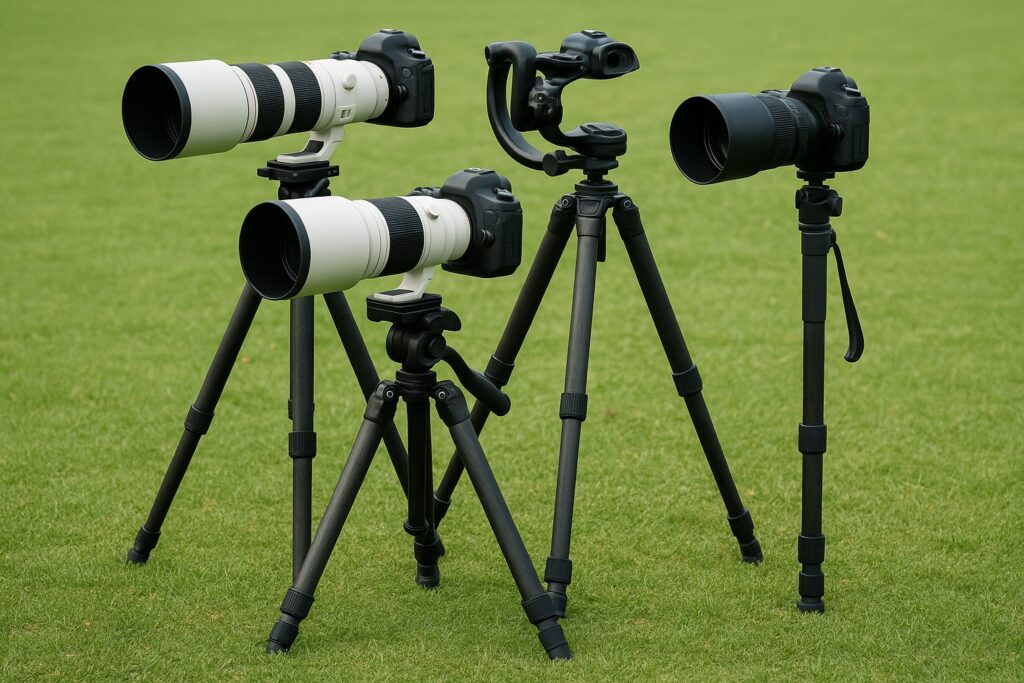
Tripods are best for static shooting situations. If you’re covering an event where you have a designated spot—like a finish line, corner flag, or elevated press box—a tripod gives you rock-solid support. You can mount your camera, compose your frame, and wait for the action to unfold.
Monopods, on the other hand, shine in fast-paced, mobile environments. They’re easier to carry, faster to set up, and allow for greater flexibility in positioning. They’re the go-to tool for sideline shooters who need to follow the action without lugging around a bulky tripod.
Top Tripods for Sports Photographers
1. Manfrotto 055 Aluminum Tripod
This tried-and-true model has long been favored by sports and wildlife photographers for its dependable build and smooth adjustments. Its quick power lock system and multi-angle center column make it adaptable for tough angles and uneven terrain.
- Weight: 5.5 lbs
- Max Height: 66.9 inches
- Load Capacity: 19.8 lbs
- Ideal For: Heavier DSLR setups, long telephoto lenses
2. Gitzo GT3543LS Systematic Series 3
If you need serious support in the field, this carbon fiber tripod delivers. It’s modular, strong, and light enough to carry to remote locations. It’s built for professionals who don’t want to compromise on stability.
- Weight: 4.3 lbs
- Max Height: 57.5 inches
- Load Capacity: 55 lbs
- Ideal For: Studio-quality sports shooting in outdoor conditions
3. Benro Mach3 TMA38CL Carbon Fiber Tripod
Benro’s carbon fiber line offers an excellent balance of performance and price. It’s lightweight enough for travel but stable enough for serious gear. Its rubber feet can be swapped for metal spikes—perfect for fields and stadiums.
- Weight: 4.5 lbs
- Max Height: 69.7 inches
- Load Capacity: 35.3 lbs
- Ideal For: Versatile sports photography across different terrains
Leading Monopods That Excel in the Field
1. Manfrotto XPRO Monopod+
Quick to deploy and built like a tank, the XPRO Monopod+ is one of the most trusted tools for fast-action shooters. The fluid base option adds stabilization during pans and tilts, especially helpful during side-to-side tracking.
- Weight: 2.4 lbs
- Max Height: 79.9 inches
- Load Capacity: 17.6 lbs
- Best For: Sideline sports where rapid movement is required
2. Sirui P-326 Carbon Fiber Monopod
This six-section monopod folds down small, yet extends tall enough for comfortable eye-level shooting. Its foam grip and wrist strap add security, and the carbon fiber construction means it’s light enough for long shoots.
- Weight: 0.9 lbs
- Max Height: 61.4 inches
- Load Capacity: 22 lbs
- Best For: Travel and quick setup without compromising durability
3. Gitzo GM4552L Series 4 Monopod
With industrial-grade carbon fiber and a maximum load capacity of over 60 lbs, this Gitzo monopod is ideal for photographers using large, fast lenses. It’s longer than most models, giving added reach at field events or racetracks.
- Weight: 1.5 lbs
- Max Height: 74.8 inches
- Load Capacity: 66 lbs
- Best For: Pro-level gear and demanding environments
Practical Tips for Maximizing Stability at Events
- Scout the Venue: Arrive early and identify where tripods are permitted. Some stadiums prohibit them outside designated media zones.
- Use a Gimbal or Ball Head: These allow smooth, fluid movement while keeping your camera balanced.
- Avoid Full Extension: Only extend the legs or monopod column as much as needed. Overextending compromises stability.
- Support with Your Body: Use your legs or arms to anchor your gear, especially with monopods.
- Balance the Load: Make sure your camera is properly mounted and centered to prevent tipping or slipping.
Invest in Stability to Elevate Your Work
In the world of sports photography, a split-second can mean the difference between a forgettable photo and a gallery-worthy capture. Don’t let poor stability hold you back. Whether you need the fixed security of a tripod or the nimble support of a monopod, investing in quality gear pays off in sharper images, smoother motion tracking, and less fatigue.
These tools are more than accessories—they’re extensions of your shooting technique. When matched with the right strategy and setting, a tripod or monopod can help you confidently shoot the high-speed action that defines sports photography.
The written content on this page was generated by ChatGPT.